Here's a scene from the film Scent of a Woman, which I will be analyzing using the Marxist and Audience Response lenses:
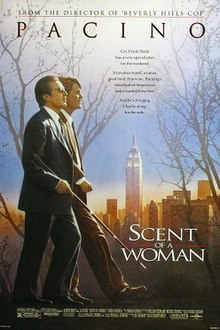
In this scene, the two main characters are meeting each other for the first time. One is Charlie, a student at a very upper-class prep-school in New Hampshire. While most of the students at this school come from very wealthy, privileged backgrounds, Charlie is from a very blue-collar family. He is seeking a job as a weekend home care assistant for a "shut-in". The other main character is Frank, who is a retired Army colonel, and is completely blind. His niece and her family (who Frank lives with) are going away for Thanksgiving weekend, and they don't want to leave Frank all alone...
Looking through the Marxist analytic lens, we notice a wide variety of class issues at work in this scene. Frank immediately has an array of preconceptions regarding Charlie, based on limited information. Knowing that Charlie is a student at a prestigious and expensive prep-school, Frank assumes that Charlie is probably a spoiled rich kid. Charlie's initial nervousness causes him to appear slightly less-than-bright, and Frank pounces upon this apparent weakness in an effort to put Charlie in a position of disadvantage and defense. Frank seems to have a fair amount of disdain and contempt for the wealthy and privileged.
But shortly into the conversation, Frank discovers that Charlie is not actually privileged at all; he comes from a quite unwealthy working-class background. Frank then seems to realize that he doesn't have to artificially bring Charlie down to a level below his own, he was already there to begin with. Furthermore, Charlie's appearance of stupidity was due simply to the nervousness of a genuinely timid young man. These realizations seem to relieve Frank, and reinforce his posture of dominance.
As the complex dance continues between these two very different individuals, we notice that Charlie is struggling to get any kind of accurate reading on Frank. What initially appeared to be an uneducated blue-collar pensioner, has turned out to be a fire-and-brimstone retired military officer. He clearly has a laundry list of character defects, not the least of which is his obvious alcoholism, yet his sharp wit, keen perception, and references to past glories imply a history of great significance. He is a mystery that Charlie cannot easily size up, and class-ambiguity almost always creates a disadvantage for the unsure party.
Shifting to an examination of the scene through the Audience Response lens, we observe a different array of issues. Looking at the composition of the shots, it is evident that the audience is being manipulated to view Charlie as weak and vulnerable, while we are expected to see Frank as a powerful, dominant character. Charlie is standing in the middle of a static shot, wearing dark clothing, surrounded by darkness. In effect, he is a little white face floating in blackness, looking helpless. Add to that his meek little voice delivering short lines, and the audience can't help but view him as helpless and vulnerable. Once Frank begins ruthlessly grilling him, we inevitably sympathize with Charlie's plight.
Shot composition also plays a role in how we view Frank. He is centered comfortably in a chair, his body language very reminiscent of a king on his throne. The tremendous beam of sunlight slashing across his lap screams "POWER" at us, and the regality of it all tells the audience that this is a man in charge. This is confirmed by the way he verbally dominates the proceedings, and creates an air of tension as the audience wonders how Charlie will ever get through this. The viewer can't help but sigh with relief when Charlie finally gets out of there...

I always liked how movies use blindness as a storytelling tool. You know that since this person cannot see with his eyes, he must use his intuition and ability to read people for who they really are. So, we can usually trust blind people's character judgments in film. This happens here too: Frank sees Charlie for what he really is; now that Charlie knows he's not fooling anyone, he can change.
ReplyDeleteIt's also interesting to note the binary class presents. You are either rich or poor; if you are poor at a rich school, you will automatically not fit in. If Charlie were rich, would Frank be able to see him as a meek man who needs some excitement? Who knows?